
[ad_1]
In 1964, the workplace cubicle was born. For which you can thank Robert Propst, a designer on the Herman Miller furnishings firm. 4 years earlier, he had proposed a radical different to the workplace bullpen: the Motion Workplace. He envisioned it as a holistic and built-in system designed to extend employee effectivity whereas offering an ergonomic workspace.
Sadly, the Motion Workplace quickly devolved into soulless cubicle farms, pilloried in Dilbert cartoons and despised by workplace employees in all places. Chief among the many complaints: noisy coworkers and a scarcity of privateness.
To handle each points, Propst and Jack Kelley created the Acoustic Space Conditioner in 1975. The AAC was a noise-canceling system designed to hush undesirable background chatter. The globe grew to become identified across the firm because the maskitball. “It was basketball season,” Kelley defined to Kristen Gallerneaux, a curator at The Henry Ford (the place the AAC pictured beneath resides). The moniker caught.
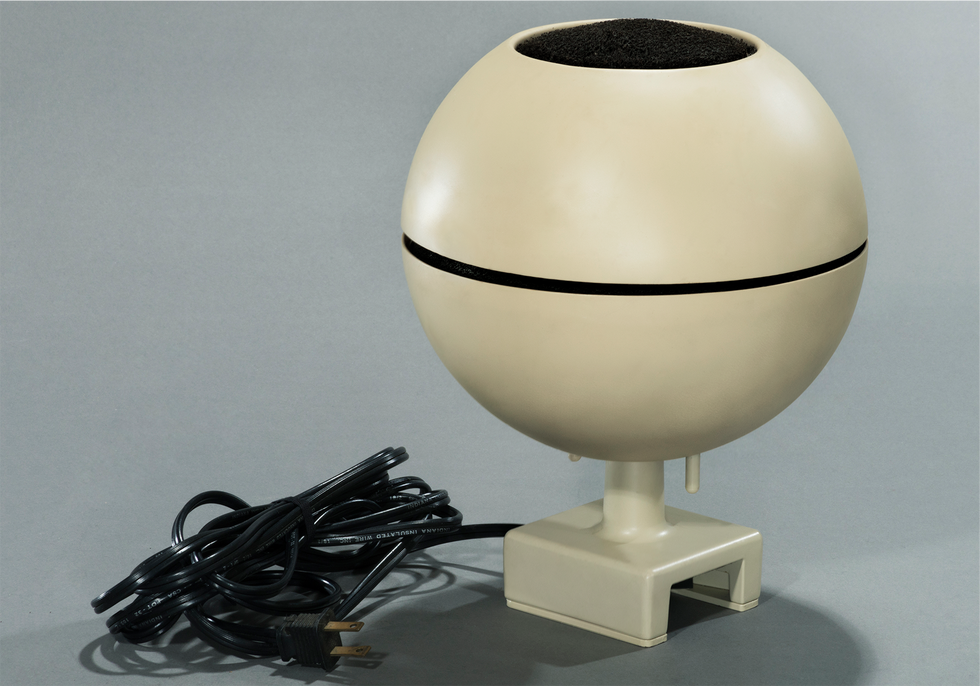 Henry Miller’s Acoustic Space Conditioner was a white-noise machine for company workspaces.The Henry Ford
The 19-centimeter-diameter globe was certainly just a bit smaller than a basketball. It perched atop a cubicle wall roughly 2 meters from the ground. Excessive frequencies had been emitted from the highest of the globe and mid- and low-level frequencies from the equator. Workplace employees may tune the system inside preset limits. In bigger open workplaces, AACs might be spaced each 3 to three.5 meters to create a white-noise zone.
The idea and actuality of Herman Miller’s Motion Workplace
The AAC was half of a bigger effort at Herman Miller to optimize workplace acoustics. Propst and Michael Wodka wrote The Motion Workplace Acoustic Handbook: A Information for the Open Plan Facility Supervisor, Planner and Designer (Herman Miller Analysis Corp., 1975) as a guide for designing open-office workspaces.
This video exhibits the Motion Workplace and its successor, the Motion Workplace 2:
The Historical past of Herman Miller Motion Workplace II (AO2)www.youtube.com
The ebook lays out quantitative guides for greatest practices, reminiscent of not having to talk louder than 60 decibels over a distance of 1.8 meters for regular dialog. The background hum of a typical workplace they put at 40 to 50 dB. It’s not all about maintaining quiet, although. They counsel creating pockets of “bustle,” to kind a blanket of sound. When issues are too quiet, particular person sounds will stand out and startle and irritate employees.
The vast majority of the handbook pertains to area configuration. Small cubicles tightly packed in rows—the setup I’ve all the time had the misfortune to work in—had been deemed an absolute no-no. Propst and Wodka known as these unhappy cubicles “a clean little island in a sea of sub-enclosures the place excessive density and excessive invisibility are mixed with irritating outcomes.” Fact. They termed the issue “relationship blindness,” as a result of individuals disappear visually and develop into mere disembodied voices.
I first encountered a poorly applied model of the Herman Miller Motion Workplace proper out of school, once I went to work for a big consulting agency. It was dismal.
Once I shifted to a federal authorities job, I gained entry to the whole Herman Miller design ebook and drooled over the numerous doable configurations of my new cubicle—till my boss advised me there was no funds for my dream workspace. Certainly, the underside line is principally what doomed the Motion Workplace. All through company America, financial realities collided with Propst’s imaginative and prescient as managers tried to jam extra individuals into an outlined area with little regard for employee or workspace wants. Standardization, moderately than configurability, grew to become the norm.
Propst got here to remorse his invention of the Motion Workplace. Close to the top of his life, he lamented, “Not all organizations are clever and progressive. Heaps are run by crass individuals. They make little, bitty cubicles and stuff individuals in them. Barren, rathole locations.”
The Motion Workplace nonetheless has relevance immediately
Propst might have had regrets, nevertheless it’s value revisiting the concepts that led him to design the Motion Workplace within the first place. Most of them are outlined in his 1968 ebook, The Workplace: A Facility Primarily based on Change (Enterprise Press Worldwide).
“Nose to nose involvement is the premier communication software,” Propst wrote. “Unmatched for subtlety and effectivity but additionally a gift wasteland of mysterious inhibitions and limitation, it requires revisualization.”
Propst thought deeply about efficient communication in an workplace—the varied challenges of an excessive amount of communication, redundant communication, out-of-date communication, insulated communication, and low-grade data. He noticed the disastrous results of poor workplace layouts on communication, and the follow-on results on employees’ creativity and motivation, what immediately we’d name burnout. He acknowledged that duties may take hours, days, and even weeks to finish and that workplace workstations ought to replicate these timescales. Propst understood the intense well being issues {that a} sedentary desk job may induce and labored so as to add motion and move to the workplace. He pushed for giving employees choices and management over their workspace. Lastly, he believed that employees must be allowed to vary their minds and reply to errors as they emerge. He believed in grace with change.
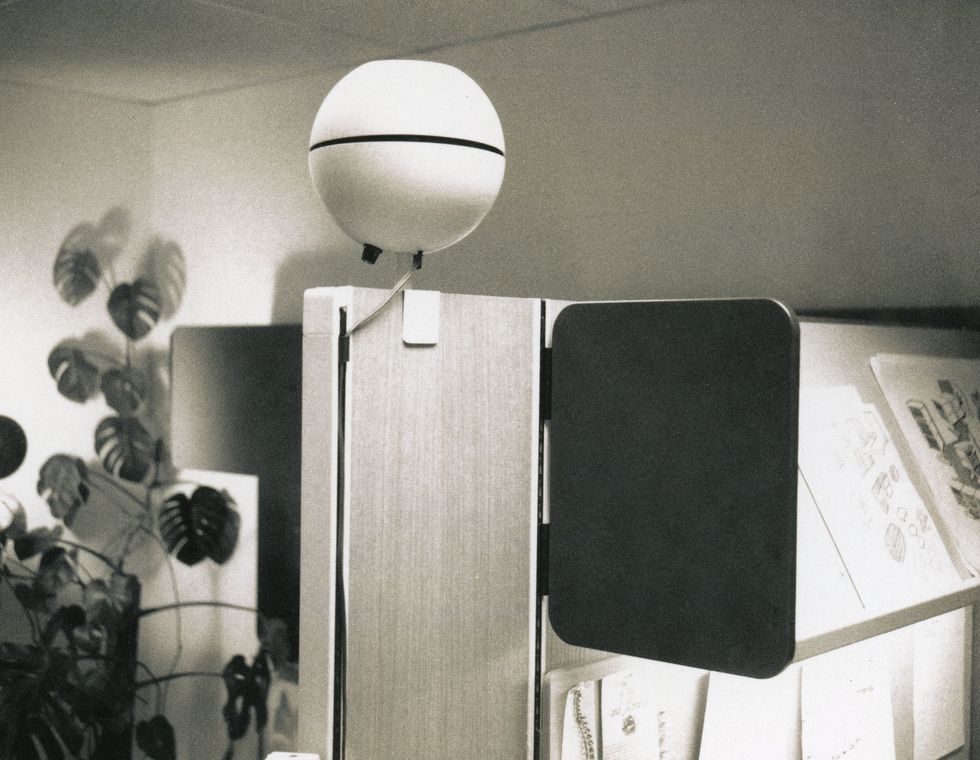 The Acoustic Space Conditioner was just a bit smaller than a basketball—therefore its nickname inside the firm: the maskitball. The Henry Ford
Understanding how a lot thought and care Propst invested in his idea for the Motion Workplace, I perceive extra clearly why he was so very upset with the way it performed out in the actual world.
As for the AAC, manufacturing ceased within the early Nineteen Eighties. Maybe the maskitball was no match for private headphones to tune out annoying colleagues. The Sony Walkman had debuted in 1979, offering employees the flexibility to hearken to music with out disturbing their neighbors. In 2000, the Bose Corp. launched its Quiet Consolation line of noise-canceling headphones. And immediately, noise-canceling options in earbuds are commonplace. Now that we’ve got the means to deal with acoustical interruptions within the workspace, perhaps designers and engineers can flip to fixing the myriad different issues of cubicle design. Maybe it’s time to lastly embrace Propst’s Motion Workplace.
A part of a continuing seriestaking a look at historic artifacts that embrace the boundless potential of expertise.
An abridged model of this text seems within the November 2023 print concern as “White Noise, Inc.”
From Your Web site Articles
Associated Articles Across the Net
[ad_2]