
[ad_1]
For a number of years, the car trade has grappled with a simple query: Is it potential to provide a robust, environment friendly, and mass-producible synchronous motor that accommodates no rare-earth components in any respect? A newly introduced partnership between
General Motors and the startup magnet firm Niron Magnetics suggests a convincing “sure.”
That was how the media reported it on 8 November, after GM Ventures,
Stellantis Ventures, and several other different traders disclosed a US $33 million infusion into Niron’s iron-nitride magnet. On the identical time, GM and Niron introduced that they’d agreed to kind a strategic partnership to codevelop rare-earth-free everlasting magnets “that can be utilized in future GM EVs.”
Nevertheless, many consultants in magnetics are uncertain. They query whether or not it’s potential to mass-manufacture a cost-effective magnet freed from uncommon earths that’s sturdy and difficult sufficient for EV propulsion.
“There’s a compound there,” says Alexander Gabay, a researcher on the University of Delaware, referring to the iron nitride within the magnets being developed by Niron. However “it’s not intrinsically able to making an excellent magnet. It’s that easy. That is well-known locally.”
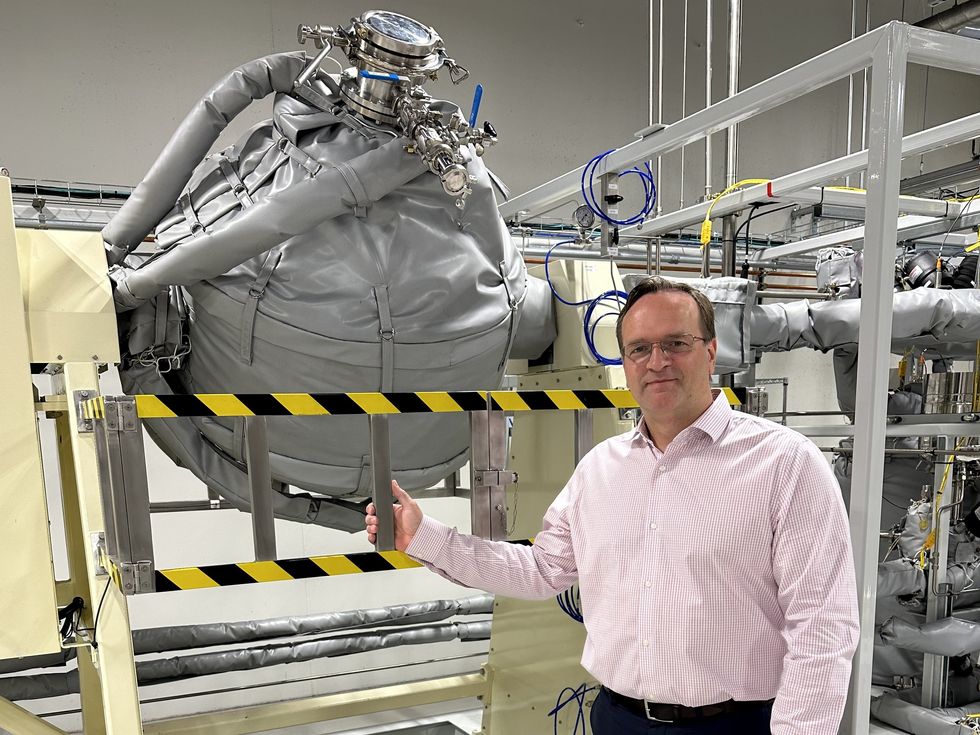 Niron CEO Jonathan Rowntree stands in entrance of a chemical reactor used to provide the corporate’s iron-nitride compound.Niron Magnetics
Automakers have spent huge sums in recent times getting ready for a transportation future dominated by electric vehicles. A part of that preparation has centered on rare-earth components. For each 100 kilowatts of peak energy, an EV motor makes use of a median of 1.2 kilograms of neodymium-iron-boron everlasting magnets, in accordance with
Adamas Intelligence. And for automakers, there are two large issues related to uncommon earths: Processing of the weather from ore has been a sometimes environmentally ruinous affair to this point. And practically 90 p.c of processed uncommon earths come from China, which implies a supply-chain dependence that spooks automotive corporations in the USA, Japan, Europe, and Korea.
“Everlasting-magnet design is a superb alternative for us to scale back our prices and environmental influence of our EV motors whereas additionally localizing our EV provide chain in North America,” stated
Kai Daniels, supervising principal at GM Ventures, on the November press convention saying the partnership with Niron.
GM isn’t the one automaker on a hunt for rare-earth-free everlasting magnets. Final March, Tesla’s director of power-train engineering triggered a minor commotion by declaring that the corporate’s “subsequent drive unit” included a permanent-magnet motor that will “not use any rare-earth components in any respect.” However basically all the consultants contacted by
IEEE Spectrumdismissed the assertion as wishful pondering.
There aren’t any easy ideas of physics and chemistry that preclude the potential of a robust and sturdy everlasting magnet that makes use of no rare-earth components and whose magnetism survives at excessive temperatures. Certainly, such a magnet already exists—platinum cobalt (which regularly incorporates boron as properly). Nevertheless, the magnet is way too costly for business use. It additionally requires cobalt, whose provide
is so fraught that magnets incorporating the factor make up a relatively small percentage of the permanent-magnet market.
“I name it the perversity of nature,” jokes
Matthew Kramer, Distinguished Scientist at Ames National Laboratory, in Iowa. “The dearer it’s, the extra poisonous it’s, the higher the supplies that may come out of it.”
Any everlasting magnet should have a ferromagnetic factor, reminiscent of iron or cobalt. To grasp why, begin with the fundamentals: Everlasting magnetism happens in sure crystalline supplies when the spins of electrons of a number of the atoms within the crystal are pressured to level in the identical course. The extra of those aligned spins, the stronger the magnetism. For this, the perfect atoms are ones which have unpaired electrons swarming across the nucleus in what are often called
3d orbitals. Iron has 4 unpaired 3d electrons, and cobalt, three.
However unpaired 3d electrons aren’t fairly sufficient for a extremely sturdy and sensible everlasting magnet. To get superlative efficiency, that you must house these atoms out within the crystalline lattice with sure atoms containing unpaired 4f electrons. These specific atoms all belong to the group of rare-earth components.
“There are very fascinating underlying physics related to the uncommon earths that the opposite transition metals simply don’t have,” explains Kramer. “And that includes these internal, 4f, electrons. It provides you the flexibility to have atoms that may type of push the opposite transition metals additional aside. As a result of the trick to getting a extremely good ferromagnet is, that you must get a number of spins—however these spins all have to be separated in simply the fitting distances relative to which transition steel you’re taking a look at [iron or cobalt].”
The particular rare-earth components are neodymium, praseodymium, samarium, and dysprosium. What that spacing does is present a steady ferromagnetic construction within the crystal, which in flip promotes an inherent attribute of the crystal known as magnetic anisotropy. When the crystal of a magnetic materials is comparatively simple to magnetize alongside sure axes in contrast with others, the fabric is alleged to have sturdy magnetocrystalline anisotropy. This attribute is important for producing an excellent and helpful everlasting magnet, as a result of with out it the magnet can not have what is named excessive coercivity—the flexibility to withstand demagnetization.
“Nature doesn’t need the magnetization to be aligned in a single course; it desires it to interrupt down into oppositely directed domains,” says Gabay. “That’s why you want sturdy anisotropy—to carry the magnetization in line,” he provides.
Magnetocrystalline anisotropy is the query mark hanging over Niron’s magnet, iron nitride. A sensible measure of such a anisotropy is its magnetic hardness, a “arduous” materials being outlined as one which strongly resists demagnetization.
In a 2016 paper, researchers on the College of Nebraska and Trinity Faculty, Dublin, analyzed dozens of actual and hypothetical permanent-magnet supplies and got here up with a parameter, κ, to compactly point out this hardness. They asserted that “by drawing the road for magnetic hardness at κ = 1, the rule of thumb for potential success in compact everlasting magnet improvement is that the fabric must be arduous”—in different phrases, have a κ larger than 1.
The paper included a desk of magnetic supplies and their κ values. The usual everlasting magnet utilized in EV motors, neodymium iron boron, has a κ of 1.54, in accordance with this desk. For iron nitride, the authors gave a κ worth of 0.53. (Neodymium-iron-boron magnets, by the way in which, had been
invented in the early 1980s individually by two groups of researchers, one in every of which was at Basic Motors.)
If Niron has discovered a method across the obvious anisotropy downside of iron nitride, they’d after all fastidiously guard such immensely helpful mental property. The worldwide marketplace for neodymium magnets is properly within the
billions of dollars per yr and rising.
However Gabay isn’t shopping for it. “In our area, the main gathering known as the
International Workshop on Rare-Earth and Future Permanent Magnets. [At the most recent one, in September] Niron had a presentation, the place they had been saying a number of phrases, however they by no means confirmed any information. Individuals requested them to indicate one thing, however they by no means confirmed something.”
Requested concerning the anisotropy difficulty with iron nitride, Niron’s chief technical officer,
Frank Johnson, responded in an electronic mail: “The primary response of many within the magnetics neighborhood is to say that iron nitride can’t act as a drop-in substitute for rare-earth magnets in EV motors. They’re, after all, completely right. Iron nitride is a brand new magnetic materials with its personal stability of properties. Profiting from a brand new materials requires design optimization…. Partnering with world class e-machine designers, together with these at traders GM and Stellantis, is the hyperlink between breakthrough materials properties and the subsequent technology of rare-earth-free motors.”
On the November press convention, GM Ventures’ Daniels and two members of GM’s communications crew declined to say when GM anticipated the iron-nitride magnets to be prepared to be used in a mass-market EV traction motor. However in an interview with Spectrum this previous March, Niron’s government vp, Andy Blackburn, prompt that magnets appropriate to be used in EV motors could possibly be out there as quickly as 2025.
From Your Website Articles
Associated Articles Across the Net
[ad_2]